
Industrial Lyophilization Technology: Fruit and Pet Food Processing Guide
Global demand for high value-added food products — such as crispy tropical fruits, dehydrated vegetables and ultra-premium pet food (raw diets/BARF) — has driven industrial processing to evolve beyond conventional heat drying. A industrial freeze drying (known worldwide as freeze-drying) has been consolidated as the reference standard for preservation that maintains the organoleptic, nutritional and structural integrity of inputs.
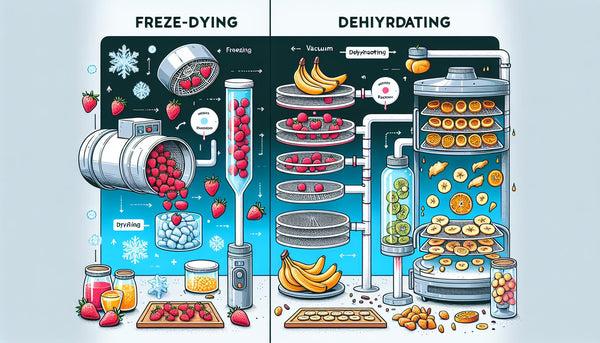
Unlike hot air dehydration, which uses high temperatures and causes cell retraction (shrinkageand loss of volatile compounds, lyophilization operates under conditions of deep vacuum and cryogenic temperatures, removing water by Sublimation.
In this technical article, we explore the physico-chemical mechanics of freeze-drying and its practical application in the processing of fruit and pet snacks.
The Physical Principle: Sublimation at the Triple Point of Water
The operation of freeze drying is based on the thermodynamic properties of water. When operating in Triple Point of Water (temperature of $0{,}01^\circ\text{C}$ and pressure of $611{,}65\text{ Pa}$or$0{,}006\text{ atm}$Liquid water ceases to exist in a stable form.
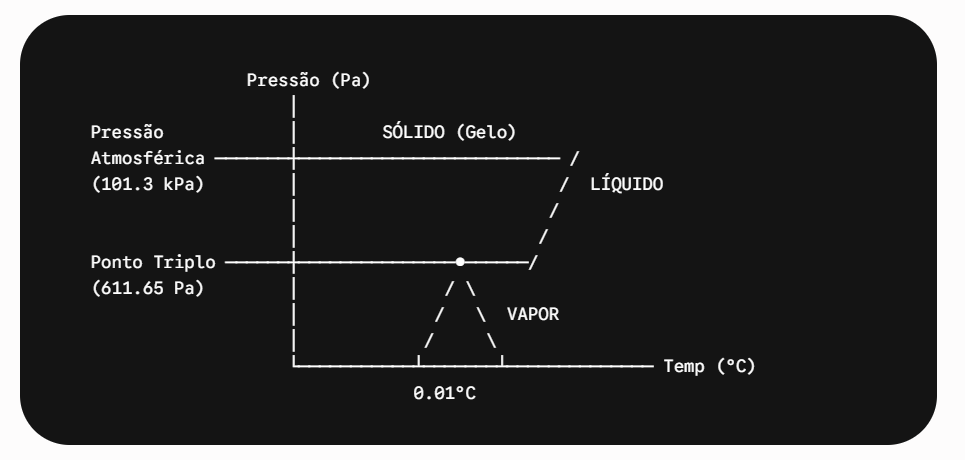
By providing controlled thermal energy under deep vacuum conditions (usually between $10\text{ Pa}$e$50\text{ Pa}$), the ice retained in the product matrix passes directly from the solid state to the gaseous statewithout passing through the liquid state.
This phenomenon prevents the collapse of the cell wall of plant and animal tissues, ensuring a highly porous structure.
The Three Stages of the Industrial Lyophilization Cycle
A complete industrial-scale freeze-drying cycle is divided into three critical phases operated with millimeter accuracy:
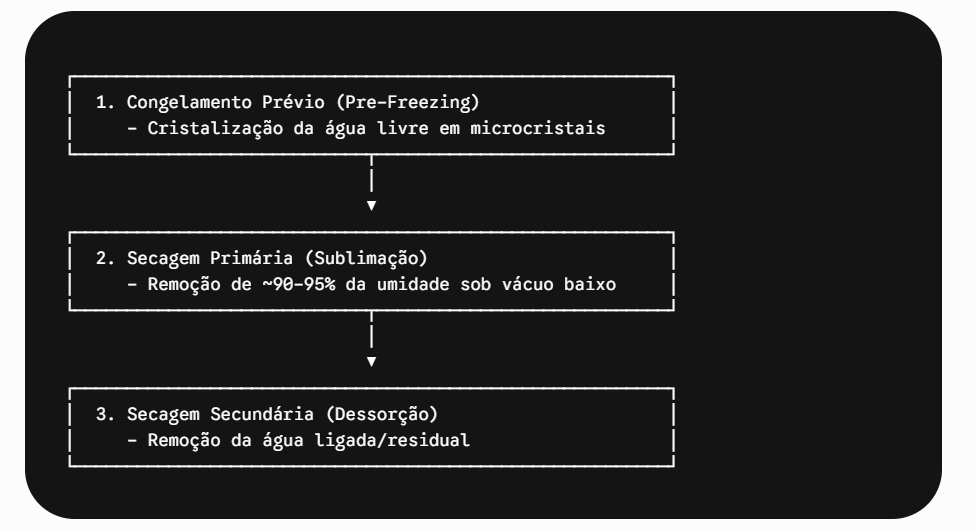
1. Pre-Freezing
The raw material (be it slices of mango, whole strawberries or blocks of raw meat) is subjected to ultra-fast freezing reaching temperatures between $-35^\circ\text{C}$e$-50^\circ\text{C}$Quick freezing is critical: it creates ice microcrystals that do not pierce the cell membranes, preserving the texture of the product after rehydration.
2. Primary Drying (Sublimation)
With the chamber under deep vacuum, radiant plates apply soft thermal energy. The ice sublimates and the water vapor migrates to the condenser (ice frame), which operates at extremely low temperatures (often $-50^\circ\text{C}$a$-80^\circ\text{C}$). This step removes close to 90% a 95% free water contained in the food.
3. Secondary Drying (Desorption)
To ensure long-term microbiological stability, moisture molecularly bound to proteins and carbohydrates must be removed. The temperature of the plates is slightly elevated while the vacuum pressure is reduced to a minimum. The final moisture content of the product is reduced to 1% a 3%.
Technology Comparison: Lyophilization vs. Traditional Methods
| Quality Parameter | Freeze-drying | Hot Air Drying | Spray drying (spray drying) |
| Process Temperature | Low Cryogenics ($<40^\circ\text{C}$) | High ($60^\circ\text{C} - 120^\circ\text{C}$) | Very High ($150^\circ\text{C} - 200^\circ\text{C}$) |
| Retention of Vitamins/Antioxidants | > 95% | 30% – 50% | 40% – 60% |
| Structure and Form | Maintains original volume and shape | Shrinking and hardening | Reduced dust |
| Rehydration Speed | Instant (sponge effect) | Slow / Partial | N/A (already powder) |
| Shelf-life | Up to 25 years (in hermetic packaging) | 6 to 12 months | 12 months |
High Performance Industrial Applications
Fruit and Vegetable Processing
Freeze-drying is especially suitable for tropical fruits with high sugar content and heat-sensitive compounds (such as banana, pineapple, acai, strawberry and mango). Since there is no caramelization of sugars or degradation of natural pigments (anthocyanins, carotenoids), the final product maintains the vivid color and intense natural flavor.
Pet Food and Nutraceutical Food Industry
In the manufacture of snacks and animal feed (raw pet food / BARF), lyophilization eliminates the risk of bacterial contamination by keeping the raw proteins free from thermal denaturation. The porosity of the freeze-dried product allows tutors to rehydrate the food with warm water in seconds, returning the snack to its original fresh state.
Considerations on Process Engineering
To ensure energy efficiency and batch-to-batch consistency in large-scale industrial plants, three technical factors are essential:
Capacity of Steam Condenser: The surface area and cooling system of the condenser must support the maximum sublimation rate without vacuum loss.
Heat Transfer Uniformity: Drying shelves must have a minimum temperature deviation ($\le \pm 1^\circ\text{C}$to prevent localized defrosting (melt-back).
Intelligent Vacuum Control: The use of capacitive sensors and pirani control allows to optimize heat conduction in the vacuum without compromising the melting point of the product.
Conclusion
Industrial freeze drying technology represents the pinnacle of food preservation engineering. By mastering the parameters of sublimation and thermal control under vacuum, the food processing and pet food industries are able to deliver products of the highest quality that meet the strict standards of the international market.
Original link: https://www.dachangequip.com/ldgzjzx/298.html
Note: The copyright belongs to Ganzhou Dachang Air Conditioning Equipment Engineering Co., Ltd. For commercial reprints, please contact the author for authorization. For non-commercial reprints, please indicate the source.
Related Recommendations
Freeze drying machine information


Add WeChat
Main products: Vacuum pre cooling equipment, archive insecticidal disinfection and sterilization equipment, vacuum freeze dryer, thawing equipment, cultural relic archive image restoration equipment, low oxygen insecticidal disinfection machine, vacuum deodorization machine, dust removal disinfection and purification equipment, ultra-high pressure sterilization equipment, low oxygen chamber animal comfort equipment
Copyright © 2026 Dachang Equipment Equipment All rights reserved. XML
XML