
Industrial Freeze Dryer Capacity: How to Choose the Right Size for Your Production
Choosing the rightindustrial freeze dryer capacityis one of the most important decisions before investing in a freeze drying machine.
A machine that is too small may limit production and increase processing costs. A machine that is too large can increase the initial investment, energy consumption, installation requirements, and unused capacity.
However, freeze dryer capacity is not simply about choosing the machine with the largest kilogram rating. The actual production capacity depends on several factors, including product type, water content, loading thickness, drying cycle, tray area, condenser capacity, and required daily output.
What Does Industrial Freeze Dryer Capacity Mean?
When manufacturers discuss the capacity of anindustrial freeze dryer, they may use different specifications.
Common capacity measurements include:
· Fresh product load per batch
· Dry product output per batch
· Tray or shelf area
· Kilograms of water removed per batch
· Daily production capacity
· Condenser ice capacity
For example, two industrialfreeze drying machinesmay have similar tray areas but produce different results because their refrigeration systems, vacuum systems, heating systems, and product loading conditions are different.
Therefore, buyers should not compare machines based only on one capacity number.
1. Start With Your Required Production
The first step is to determine how much product you actually need to process.
For example, a company may need to process:
· 100 kg of fresh fruit per day
· 300 kg of pet food per day
· 500 kg of vegetables per day
· 1,000 kg of coffee or other ingredients per day
These requirements should be converted into a realistic batch-production plan.
If a machine processes 200 kg per batch and requires approximately 20 hours for one complete cycle, its daily production will be very different from a machine with the same nominal loading capacity but a shorter cycle.
This is why buyers should consider bothbatch capacity and cycle time.
2. Product Type Directly Affects Capacity
Different products behave differently during freeze drying.
Fruits and vegetables may contain a high percentage of water, while pet food, meat, coffee, herbs, and pharmaceutical materials can have very different moisture contents and structures.
Product thickness also matters.
Thin pieces generally allow water vapor to escape more easily than thick products. If the loading layer is too thick, the primary drying stage can take longer.
For this reason, an industrial freeze dryer designed for fruit pieces may not have the same practical production capacity when processing another product.
The machine should therefore be selected according to the actual product rather than capacity alone.
3. Tray Area Is an Important Specification
For commercial and industrial freeze drying equipment,shelf areaortray areais another important parameter.
A larger shelf area allows more product to be loaded into the chamber.
Some industrial systems on the market offer shelf areas ranging from several square meters to hundreds of square meters, depending on the production scale and application.
However, larger shelf area does not automatically mean higher production.
The product loading density, tray dimensions, product thickness, heat transfer, and drying cycle must also be considered.
When comparing suppliers, ask for:
· Total shelf area
· Number of shelves
· Effective loading area
· Recommended loading thickness
· Recommended loading density
· Fresh product capacity per batch
These figures provide a much clearer picture of the machine's real production capability.
4. Condenser Capacity Also Matters
The condenser is responsible for capturing water vapor during the drying process.
If a product contains a large amount of water, the freeze dryer needs sufficient condenser capacity to handle the vapor generated during primary drying.
Therefore, buyers should not look only at the chamber size.
The refrigeration system and condenser should be matched with the expected water load.
For larger industrial systems, manufacturers may specify condenser capacity in kilograms of ice or water removal performance. Some production freeze dryers are designed with condenser capacities ranging from tens to thousands of kilograms, depending on the equipment class.
A properly matched condenser helps maintain stable vacuum and drying conditions throughout the process.
5. Calculate Capacity From Your Daily Production
A simple way to estimate the required machine size is:
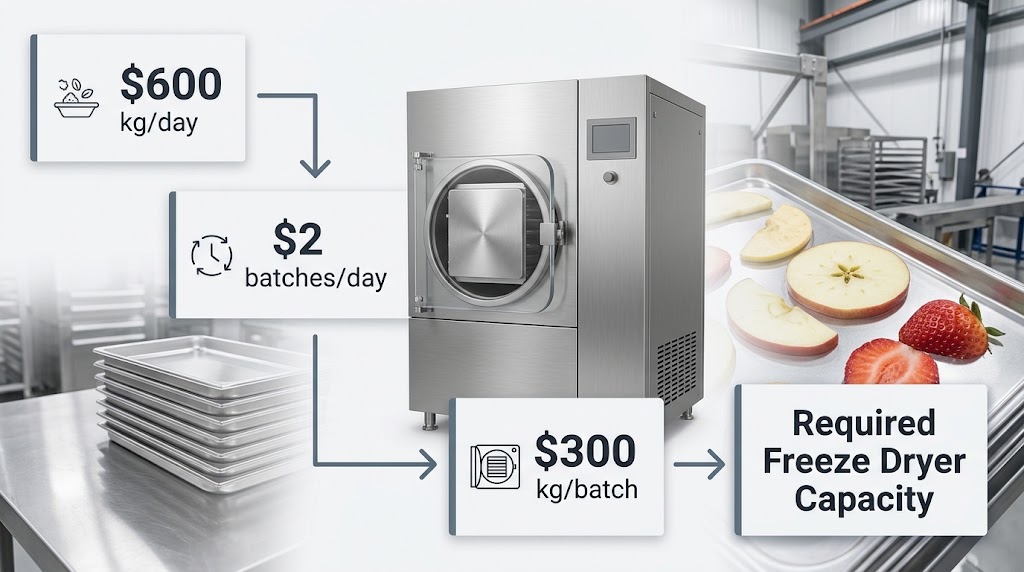
Required batch load = Daily production ÷ Number of batches per day
For example, if a factory needs to process approximately 600 kg of fresh material per day and expects to run two batches per day:
600 kg ÷ 2 = 300 kg per batch
The initial equipment requirement would therefore be around 300 kg of fresh product per batch.
However, this is only a preliminary calculation.
The actual machine size should also consider downtime, loading and unloading time, cleaning, product moisture content, and the actualfreeze drying cycle.
For a factory that operates continuously, it may also be more practical to use multiple smaller machines rather than one very large machine.
6. Food, Pet Food and Pharmaceutical Applications Are Different
The required capacity also depends on the industry.
Food Freeze Drying
Food manufacturers may process fruits, vegetables, meat, seafood, coffee, dairy products, prepared foods, herbs, and other ingredients.
The main considerations are usually:
· Fresh product loading
· Daily production
· Product thickness
· Final moisture
· Drying cycle
· Product quality
· Cleaning requirements
Pet Food Freeze Drying
Pet food manufacturers may process meat, raw pet food, treats, organs, and other animal-based products.
In addition to capacity, they may pay particular attention to:
· Batch consistency
· Sanitation
· Product loading
· Drying uniformity
· Production efficiency
· Easy cleaning
Pharmaceutical Freeze Drying
Pharmaceutical freeze drying has different requirements.
The equipment may need to process vials, biological materials, active ingredients, or other sensitive products. Pharmaceutical systems can require tighter temperature control, process validation, aseptic design, CIP/SIP, and extensive documentation.
Therefore, a pharmaceutical freeze dryer should not be selected using the same criteria as a food production machine.
7. Do Not Choose a Machine Based Only on “kg per Batch”
When requesting quotations from different suppliers, buyers should ask for a complete technical specification.
A useful comparison sheet should include:
Parameter | What to Check |
Fresh product capacity | kg/batch |
Shelf area | m² |
Shelf number | layers |
Condenser capacity | kg ice |
Condenser temperature | °C |
Vacuum level | Pa or mbar |
Heating temperature | °C |
Typical cycle time | hours |
Product type | fruit, meat, pet food, etc. |
Loading thickness | mm |
Power consumption | kW |
Chamber material | Stainless steel |
Control system | PLC/HMI |
Installation | Included or not |
After-sales service | Available or not |
This makes it easier to compare differentindustrial freeze drying machineson a technical basis rather than simply comparing prices.
8. Leave Some Production Capacity for Future Growth
A common mistake is choosing a machine that exactly matches today's production requirement.
If a company currently needs 300 kg per day but expects production to increase to 500–600 kg per day within the next few years, a slightly larger system or modular production solution may be more economical.
However, buying excessive capacity also creates unnecessary investment.
The best approach is to consider:
Current production + expected growth + realistic utilization rate
The goal is not to buy the biggest freeze dryer. The goal is to buy a system that can operate efficiently at the required production level.
What Information Should You Give a Freeze Dryer Manufacturer?
Before requesting a quotation, prepare the following information:
1. Product name
2. Fresh product weight per batch
3. Required daily production
4. Product moisture content
5. Product size or thickness
6. Target final moisture
7. Desired production hours per day
8. Available factory space
9. Local electrical standard
10. Whether pre-freezing equipment is required
With these details, a manufacturer can make a much more accurate recommendation.
For example, a fruit processor looking for 500 kg/day capacity may require a different system from a pet food manufacturer with the same 500 kg/day target.
Conclusion
Choosing the rightindustrial freeze dryer capacityrequires more than comparing kilograms per batch.
The most important factors include fresh product load, shelf area, product characteristics, drying cycle, condenser capacity, daily production requirements, and future expansion.
For food, pet food, pharmaceutical, coffee, fruit, vegetable, and other applications, the equipment should be designed around the actual production process.
Before purchasing an industrial freeze drying machine, ask the supplier to provide the complete technical specifications and explain how the stated capacity is calculated.
A correctly sized freeze drying system can help manufacturers achieve more consistent production, better equipment utilization, and a more reasonable investment.
If you are planning a new freeze drying production line, the first step is to calculate your required batch capacity and daily output before selecting the machine model.
Original link: https://www.dachangequip.com/ldgzjzx/344.html
Note: The copyright belongs to Ganzhou Dachang Air Conditioning Equipment Engineering Co., Ltd. For commercial reprints, please contact the author for authorization. For non-commercial reprints, please indicate the source.
Related Recommendations
Freeze drying machine information

Add WeChat
Main products: Vacuum pre cooling equipment, archive insecticidal disinfection and sterilization equipment, vacuum freeze dryer, thawing equipment, cultural relic archive image restoration equipment, low oxygen insecticidal disinfection machine, vacuum deodorization machine, dust removal disinfection and purification equipment, ultra-high pressure sterilization equipment, low oxygen chamber animal comfort equipment
Copyright © 2026 Dachang Equipment Equipment All rights reserved. XML
XML