
How industrial-grade freeze-drying technology is transforming fruit and pet food production processes
In recent years, the demand for high-value dried agricultural products, especially hot citrus fruits such as tulips and mangoes, and high-quality freeze-dried pet food. Growing rapidly across Southeast Asia, to meet global quality standards, food manufacturers are increasingly shifting from traditional heat drying methods to industrial vacuum freeze drying (Lyophilization) technology.
Unlike conventional air drying or spray drying, which inhabits high temperatures that degrade heat-sensitive nutrients, colors, and flavors, freeze drying operates through low-temperature and low-pressure state changes called immersion.
In this technical overview, we will explain how modern freeze-drying technology works and why it has become the gold standard in food extraction for fruit and pet food.
Key Principle: Understand the Submersion of Ice
An important heart of industrial freeze drying is the three-state point of water. When atmospheric pressure drops below 611 Pa (0.006 atm) and a constant temperature below 0°C, water cannot remain in the liquid state.
When gently heated under high vacuum conditions, the solid ice crystals present in the product meat change to steam directly without passing through the liquid state.
This special process helps maintain the traditional physical structural condition of the product cell wall, preventing shrinkage, collapse or hardening.

3 key steps of industrial freeze drying
A complete industrial-scale freeze-drying cycle consists of three carefully controlled steps:
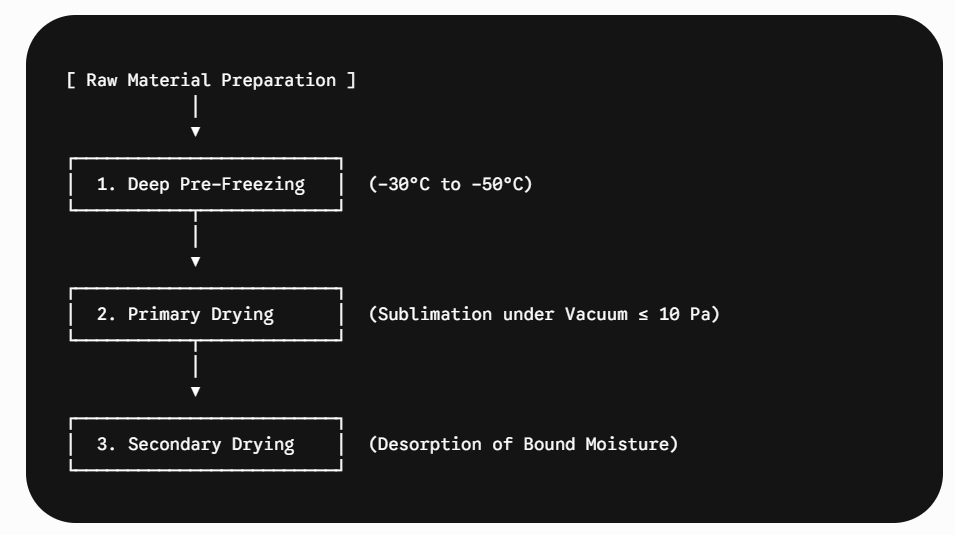
1. Pre-freezing procedure
Raw materials, whether chopped turmeric, chopped tomatoes or fresh meat, are rapidly frozen at temperatures between -30°C to -50°C. Rapid freezing creates very small ice crystals, which helps prevent the breakage of fragile plant cells or animal muscle tissue.
2. Initial drying (sublimation)
The vacuum system reduces the pressure in the drying chamber to $letext{ Pa}$. The heating plate will gradually transmit the energy through radiation/heat conduction to expel the steam away. In this initial step, approximately 90% to 95% of all moisture is removed.
3. Second stage drying (absorption)
The moisture trapped within the cell’s molecular wall evaporates by slightly increasing the temperature under very low pressure. This process reduces the final residual moisture content to less than 2%–3%, allowing it to be stored for up to 25 years without chemical preservatives.
Application focus: why freeze drying occupies an important market
Hot City Fruit (Turin, Mango, Pineapple, Banana)
Structural Condition Maintenance: High-sugar fruits tend to stick and become caramelized when exposed to heat. Immersion helps maintain the transparent texture and frame, which is popular in the export market.
Flavor and smell stability: the volatile aromatic compounds that are heated are perfectly preserved, keeping the aroma of the hot city fruit.
Nutritional Value Stability: Vitamin C, antioxidants and traditional pigments degrade by less than 5% compared to a loss of more than 50% in heat drying.
2. Raw meat pet food and snacks (BARF food)
Protein and probiotic integrity: raw meat snacks retain their natural amino acid structure, enzyme activity, and heat-sensitive nutrients, which are essential for the health of the pet's digestive system.
2. Raw meat pet food and snacks (BARF food)
Protein and probiotic integrity: raw meat snacks retain their natural amino acid structure, enzyme activity, and heat-sensitive nutrients, which are essential for the health of the pet's digestive system. Quick moisture recovery: The honeycomb-like porous structure caused by the submersion of the ice allows the frozen dry raw meat to regain moisture in warm water within seconds. Immediately return to fresh meat condition.
Antimicrobial safety: Deep freezing and vacuum dry storage together inhibit the growth of microbes and bacteria naturally, without causing protein degradation due to heat.
Key technical factors for industrial scale-up of production
For food processing plants that plan to expand commercial production, three engineering factors determine production efficiency:
Capacity of condenser trap: with the cooling trap (condenser), the temperature must be kept below -50℃ to -80℃ to freeze and store steam immediately. Maintain the stability of the vacuum level.
Thermal Uniformity: Temperature fluctuations in the drying rack will lead to uneven moisture levels or molten products (eutectic collapse).
Energy Management: Vacuum freeze dryers require optimal heat transfer designs (e.g., special liquid heating systems) to reduce the per ton electricity consumption of the finished product.
Summary
Understanding the thermodynamic mechanics of freeze drying technology enables food processors to elevate product quality, expand export scope, and meet the stringent demands of the high-end consumer market. Whether it is hot city fruit extraction or high-quality pet food production, freeze drying continues to be the leading technology for today's food extraction.
Original link: https://www.dachangequip.com/ldgzjzx/297.html
Note: The copyright belongs to Ganzhou Dachang Air Conditioning Equipment Engineering Co., Ltd. For commercial reprints, please contact the author for authorization. For non-commercial reprints, please indicate the source.
Related Recommendations
Freeze drying machine information


Add WeChat
Main products: Vacuum pre cooling equipment, archive insecticidal disinfection and sterilization equipment, vacuum freeze dryer, thawing equipment, cultural relic archive image restoration equipment, low oxygen insecticidal disinfection machine, vacuum deodorization machine, dust removal disinfection and purification equipment, ultra-high pressure sterilization equipment, low oxygen chamber animal comfort equipment
Copyright © 2026 Dachang Equipment Equipment All rights reserved. XML
XML