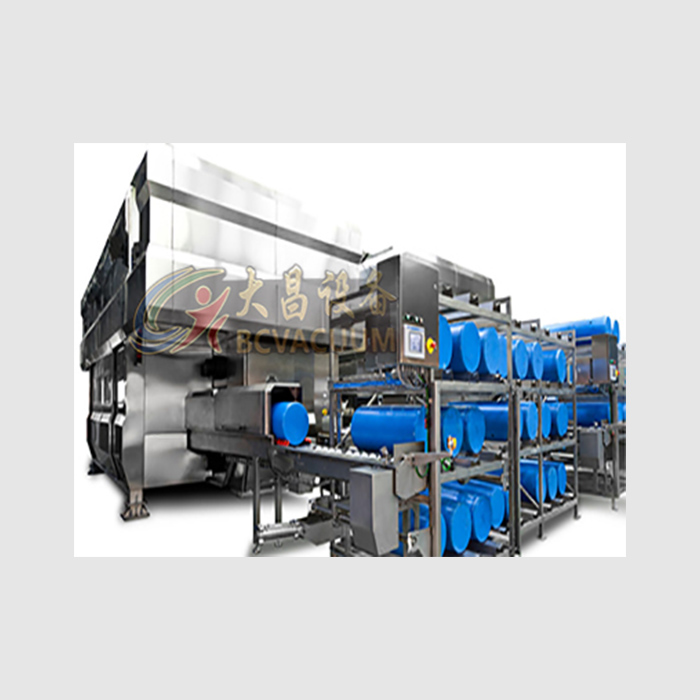
Ultra high pressure cold isostatic pressing equipment

The unique feature of ultra-high pressure technology in food processing is that it does not raise the temperature of the food, but only acts on non covalent bonds. Covalent bonds are basically not destroyed, so the original color, aroma, taste, and nutritional components of the food are less affected.
  • Model/Taiwan

    DCCGY-100

  • Specifications/Item

    Customization

  • price/Item

    consulting service

  • Material/Batch

    Customization

  • Product Introduction

  • Features

  • Application Areas

  • Technical Specifications

Overview

The unique feature of ultra-high pressure technology in food processing is that it does not raise the temperature of the food, but only acts on non covalent bonds. Covalent bonds are basically not destroyed, so the original color, aroma, taste, and nutritional content of the food are less affected. In the process of food processing, fresh or fermented foods can undergo discoloration, flavor change, and deterioration due to the presence of their own enzymes, which greatly affect their quality. These enzymes are food quality enzymes such as catalase, polyphenol oxidase, pectin methyltransferase, lipoxygenase, cellulase, etc. They can be activated or inactivated by ultra-high pressure treatment, which is beneficial for the quality of food. Ultra high pressure treatment can prevent microbial contamination of food, extend the storage time of food, and prolong the delicious taste of food.

Features

1. Ultra high pressure treatment will not cause any changes in the physical properties of food such as color, aroma, or taste, and will not produce any odors. After pressure treatment, the food will still maintain its original fresh flavor and nutritional content. For example, strawberry jam treated with ultra-high pressure can retain 95% of amino acids, which is significantly better in taste and flavor than jam treated with heat.

2. After ultra-high pressure treatment, the denaturation of proteins and the gelatinization state of starch are different from those after heating treatment, thus obtaining new physical properties of food.

3. Ultra high pressure processing can maintain the original flavor of food and provide cold sterilization. This type of food can be easily heated and consumed, thereby expanding the market for semi-finished food products.

4. Ultra high pressure treatment is a process of equivalent compression of liquid media in a short period of time, which achieves uniform, instantaneous, and efficient sterilization of food, and consumes less energy than heating methods. For example, Suntory Corporation in Japan uses container sterilization, and high-pressure treatment of beer can kill 99.99% of Escherichia coli.

The advantages of ultra-high pressure technology compared to traditional chemical treatment of food (i.e. adding preservatives) are:

5. No need to add chemicals to food, overcoming the adverse effects of products generated by the interaction between chemical reagents and substances in microbial cells on the human body, and avoiding the negative effects of residual chemical reagents in food on the human body, ensuring food safety.

6. Frequent use of chemical reagents can cause bacterial resistance and weaken the bactericidal effect, while ultra-high pressure sterilization is a one-time sterilization that has a significant effect on bacterial cells.

7. Ultra high pressure sterilization conditions are easy to control and have little influence from the external environment, while chemical reagent sterilization is easily affected by factors such as moisture, temperature, pH value, and organic environment, resulting in significant changes in its effectiveness.

8. Ultra high pressure sterilization can better maintain the natural flavor of food, and even improve the conformation of high molecular weight substances in food. For example, when applied to meat and aquatic products, it enhances the tenderness and flavor of meat products; Applied to raw milk, it is beneficial for the maturation and flavor of cheese, and can also increase cheese production. And chemical reagents do not have this effect.

We have briefly introduced the ultra-high pressure cold isostatic pressing equipment here. If you need more detailed information about other requirements of the equipment, please contact our staff.

1. Ultra high pressure treatment will not cause any changes in the physical properties of food such as color, aroma, or taste, and will not produce any odors. After pressure treatment, the food will still maintain its original fresh flavor and nutritional content. For example, strawberry jam treated with ultra-high pressure can retain 95% of amino acids, which is significantly better in taste and flavor than jam treated with heat.

2. After ultra-high pressure treatment, the denaturation of proteins and the gelatinization state of starch are different from those after heating treatment, thus obtaining new physical properties of food.

3. Ultra high pressure processing can maintain the original flavor of food and provide cold sterilization. This type of food can be easily heated and consumed, thereby expanding the market for semi-finished food products.

4. Ultra high pressure treatment is a process of equivalent compression of liquid media in a short period of time, which achieves uniform, instantaneous, and efficient sterilization of food, and consumes less energy than heating methods. For example, Suntory Corporation in Japan uses container sterilization, and high-pressure treatment of beer can kill 99.99% of Escherichia coli.

Ultra high pressure cold isostatic pressing equipment has a wide range of applications in multiple fields, and the following are its main application areas:

Ceramic industry:

Used for manufacturing high-quality ceramic products, such as transparent alumina ceramic tubes. By using ultra-high pressure cold isostatic pressing technology, the density and uniformity of ceramic products can be improved, thereby enhancing their mechanical properties and corrosion resistance.

Can be used to manufacture daily ceramics, architectural ceramics, special ceramics, etc., such as plates, dishes, alumina grinding balls, alumina chemical filler balls, refractory bricks, ceramic sticks, etc.

Powder metallurgy:

For metal powders, cold isostatic pressing technology can achieve a theoretical density of about 100%, causing deformation of the metal powder under high pressure, increasing density, and ultimately forming "green" parts that can be further processed.

Can be used to manufacture hard alloy parts, metal filters, etc.

Graphite and refractory materials:

In the field of graphite, cold isostatic pressing technology can be used for the manufacturing of graphite parts, improving the density and performance of graphite materials.

In the field of refractory materials, it can be used to manufacture nozzles, modules, crucibles, etc., to improve the high temperature resistance and strength of refractory materials.

Other industries:

It can also be applied in fields such as compression of electrical insulators and advanced ceramics.

It also has applications in food preservation and biopharmaceuticals, such as sterilization of food and preparation of drugs.

The application of ultra-high pressure cold isostatic pressing equipment in these fields is mainly due to its ability to provide isotropic and uniform ultra-high pressure, which causes plastic deformation of materials under high pressure, thereby achieving molding and densification. In addition, this technology also has the advantages of high molding quality, complex shape, good pressure effect, high and uniform density of the blank, small shrinkage during firing, low mold cost, and high production efficiency.

The technical parameters of ultra-high pressure cold isostatic pressing equipment vary depending on the equipment model and manufacturer, but usually include the following aspects:

Pressure range:

Usually expressed in tons (T) or megapascals (MPa), it represents the range of pressure that the equipment can apply. For example, the pressure range of certain equipment may be 0-12 tons (corresponding to 0-17 MPa) or 0-60 tons (corresponding to 0-34 MPa), while ultra-high pressure equipment may reach hundreds of megapascals or even higher.

Isostatic pressure chamber size:

Described the size of the space inside the device for placing the sample to be pressed, generally expressed in diameter and height. For example, a diameter of 50 × 150mm indicates that the inner diameter of the cavity is 50 millimeters and the height is 150 millimeters.

Piston diameter:

The diameter size of the piston in the cold isostatic press, such as φ 95mm, φ 150mm, etc. The size of the piston diameter affects the transmission and application of pressure, with larger diameters typically providing greater pressure.

Piston stroke:

The maximum distance that the piston can move inside the oil cylinder, commonly including 40mm, 50mm, etc. It determines the compressible spatial range of the sample during the compression process.

Pressure method:

The common ways of applying pressure to a cold isostatic press include electric pressurization, manual pressurization, or high-pressure pump water pre pressurization, hydraulic booster pressurization system, etc. Electric pressurization is more convenient and has a high degree of automation; Manual pressurization can be finely adjusted in certain specific situations.

Pressure compensation method:

Including automatic and manual pressure compensation. Automatic pressure replenishment can automatically replenish pressure to maintain the set pressure value when the pressure drops due to various reasons; Manual pressure supplementation requires manual operation to supplement the pressure.

Pressure holding time:

It refers to the length of time to maintain the set pressure after reaching it, which can generally be set within the range of 0-999.59 (minutes. seconds) or 0-999 minutes. The holding time is crucial for ensuring that the sample is fully compressed and achieves the expected molding effect.

Equipment power supply:

The power specifications required for equipment operation, such as 220V (50Hz/60Hz), indicate the need to connect AC power with a voltage of 220V and a frequency of 50Hz or 60Hz.

Overall dimensions:

Describe the overall length, width, and height dimensions of the cold isostatic press machine, such as 405 × 470 × 720mm, which respectively represent the length of the equipment being 405 millimeters, the width being 470 millimeters, and the height being 720 millimeters.

Equipment weight:

The weight of the cold isostatic press machine itself, measured in kilograms, such as 200kg.

Maximum work pressure:

The maximum pressure value that a cold isostatic press can withstand and apply, such as 300MPa, 400MPa, 1500MPa, etc. Beyond this pressure, the equipment may malfunction or even become dangerous.

Other parameters:

Such as the maximum pressure that the mold can withstand, pressure gauge type (such as digital display), protective cover material (such as organic glass), environmental temperature requirements, etc.

It should be noted that the above technical parameters are only examples and not all ultra-high pressure cold isostatic pressing equipment has these parameters, and the specific values may vary depending on the equipment model and manufacturer. When selecting equipment, the appropriate equipment model and technical parameters should be determined based on specific application and process requirements.


No more


HPP ultra-high pressure food sterilization equipment